Beyond Labels: The Philosophy of Direct Trade
In the global coffee industry, the word “transparency” is all too often reduced to a mere adhesive label on a glossy bag. However, for those who understand the true effort demanded by specialty coffee cultivation, transparency is not a certification that can be bought; it is a human and commercial relationship cultivated day after day. Direct Trade arose as an ethical and pragmatic response to the inefficiencies and opacity of traditional distribution channels. It represents a deliberate decision to bridge the gap between origin and destination, eliminating unnecessary middlemen who dilute the product’s value and the producer’s effort.
When conventional commodity coffee leaves a small farm in Latin America, it changes hands an average of five to seven times before reaching the roaster’s hopper in New York, London, or Tokyo. Along this intermediation chain—which involves local collectors, middlemen, massive processors, multinational exporters, international brokers, and importers—the coffee loses its identity. It is blended with lower-quality lots, and, most critically, the final price paid by the roaster is completely uncoupled from the farmer’s reality, remaining hostage to the volatility of the New York Stock Exchange’s C Market.
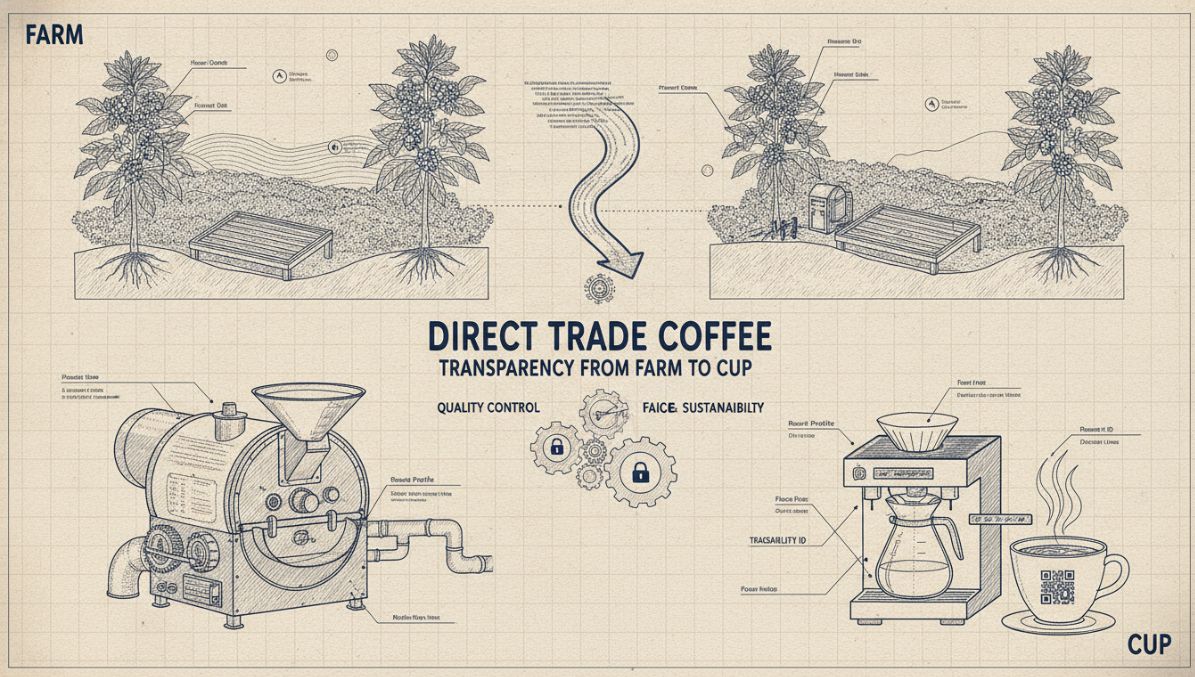
Direct Trade shatters this cycle. By establishing a direct bridge between the roaster and the farm, the coffee retains its name, its history, and its terroir. But above all, it ensures that the economic compensation to the producer is tied directly to the sensory quality of the cup (measured via standardized SCA cupping protocols) rather than the speculative swings of the stock market.
The Cafesure B.I.C. Model: Structure and Custody
At Hacienda La Florida, we understood from the beginning that sustaining a world-class specialty coffee operation required a robust and transparent export structure. Consequently, all our exports are channeled through Cafesure, an Ecuadorian specialty coffee exporting and marketing company legally certified as a Benefit and Collective Interest Society (B.I.C.).
The B.I.C. designation is not a mere marketing slogan. It is a legal framework in Ecuador that statutorily obligates the company to generate a positive social and environmental impact in the communities where it operates, placing this purpose on equal footing with financial profitability. Under this framework, Cafesure implements a strict five-phase chain of custody that guarantees absolute traceability for each microlot:
- On-Farm Harvesting and Registration: Every batch harvested daily at Hacienda La Florida is weighed, labeled with its variety, plot, and harvest date, and georeferenced with the farm’s specific GPS coordinates in Sozoranga.
- Wet Processing and Drying: The coffee undergoes specific fermentation profiles (anaerobic, natural, carbonic maceration) and is dried on raised African beds. Every step is meticulously documented in a technical log tracking temperature, humidity, and pH levels.
- Milling and Physical Sorting in Malacatos: The dried parchment is transported to the Malacatos dry mill, inaugurated in July 2025. There, it is milled and sorted using mechanical and optical sorters. Yields and physical sorting statistics are recorded.
- Sensory Analysis and Calibration: Certified Q-Graders evaluate both the green and roasted coffee, issuing an official SCA cupping sheet that is shared digitally with the international buyer.
- Direct Export and Logistics: The green coffee, vacuum-sealed in “panelitas” and reinforced cardboard boxes, is consolidated and shipped directly to the destination roaster. Middlemen brokers are bypassed, with commercial documentation sent directly.
This system ensures that the roaster receives exactly the coffee they selected on the cupping table, with the absolute certainty that the value paid directly benefits the origin.
Geography and Traceability in Practice: Microlot LJ-247
To understand how this model works in the farm’s daily reality, let us look at a real export lot from our harvest: Lot LJ-247. This lot is not an anonymous blend; it possesses a perfectly documented geographic and historical identity that we share openly with our clients:
| Traceability Parameter | Technical Detail |
|---|---|
| Farm of Origin | Hacienda La Florida |
| Producer | Coronel Pilco Family |
| Exact Location | Sozoranga, Loja Province, Ecuador |
| GPS Coordinates | 4°21’32”S 79°47’15”W |
| Botanical Variety | Typica Mejorado |
| Cultivation Altitude | 1,600 meters above sea level |
| Processing Method | Traditional Washed with extended 36-hour fermentation |
| Final Moisture Content | 11.2% constant at shipping |
| SCA Cupping Profile | 89.5 points (Notes of white peach, jasmine tea, bright citric acidity) |
When this coffee arrives at the destination roastery, the roaster can scan a code that displays all this information, allowing them to share the story of the lot with their final consumers with impeccable precision. This is not just traceability; it is an invitation to value the agricultural effort behind every cup.
From Sozoranga to the World: Global Partners
The coffee from Hacienda La Florida is not sold in bulk on international markets; it is destined for highly demanding specialty roasters who appreciate the uniqueness of our terroir and the consistency of our processes. Through our Direct Trade model, we have established long-term alliances with some of the most respected roasteries on the planet:
- Phil & Sebastian (Canada): Renowned for their scientific approach and rigorous quality control, they have been consistent buyers of our Sidra microlots, valuing the physical stability of the bean and the precision of our fermentation profiles.
- Prodigal (USA): Led by Scott Rao, one of the most influential figures in coffee roasting globally. Prodigal seeks coffees of high clarity and exceptional sweetness. Their choice of our Typica Mejorado lots validates the technical rigor of our dry mill in Malacatos.
- Sorellina (Canada): A boutique roastery that celebrates clean floral and fruit profiles. They find in Hacienda La Florida’s Sidra a perfect ambassador of Ecuador’s aromatic potential.
- Rosslyn Coffee (UK): One of the most influential specialty coffee shops and importers in Europe, located in the financial heart of London. They choose us because our Direct Trade model allows them to offer their clients impeccable ethical traceability and consistent cup quality.
These relationships are not purely transactional. They involve a constant exchange of information. Roasters send us roasting profiles, feedback on how the coffee behaves during extraction, and suggestions for future harvests, allowing us to adjust our agricultural processes year after year.
The Milestone of Matt Winton in 2021: The World Championship
The most vibrant testimony to the potential of our Direct Trade model occurred in 2021. In that year, Swiss-Australian barista Matt Winton was preparing to compete in the World Brewers Cup in Milan, the most prestigious filter coffee competition in the world. Seeking a truly unique coffee, Winton decided to bypass the usual import channels and travel directly to Sozoranga, Loja.
Winton spent several days at Hacienda La Florida. He walked the steep slopes of the Dry Forest, spoke with Fabricio and Ramiro about soil nutrition, and cupped dozens of microlots in our quality laboratory. Finally, he selected a lot of Catucaí subjected to controlled fermentation.
On the world stage in Milan, against the best baristas in the world, Matt Winton served our Catucaí. He explained to the judges the unique terroir of Sozoranga, the influence of the dry forest, and the agronomic rigor of the Coronel Pilco brothers. His flawless presentation and the extraordinary quality of the cup won him the title of World Brewers Cup Champion 2021. This achievement put the coffee of Sozoranga on the global map of ultra-premium coffee, demonstrating that when middlemen are eliminated and direct collaboration between barista and producer is fostered, there are no limits to excellence.
Direct Trade vs. Fair Trade and Commodity
To understand the structural impact of Direct Trade, it is useful to compare it with the other two dominant models in the industry:
| Dimension | Direct Trade (HLF / Cafesure) | Fair Trade (Fairtrade) | Commodity Market (NY Bolsa C) |
|---|---|---|---|
| Price to Producer | Based on cup quality (Significant premiums over production cost). | Minimum guaranteed price set, regardless of sensory quality. | Fluctuating based on speculation on the NY C Market (often below production cost). |
| Traceability | 100% Traceable to the farm plot and the producing family. | Traceable to the local cooperative, often losing the microclimate identity. | None. Coffee is blended by grade and country in massive port silos. |
| Quality Focus | Direct incentive for constant improvement through buyer feedback. | Social incentive of volume and certification, no economic reward for premium cups. | None. Volume and low processing cost are rewarded. |
Fair Trade plays an important social role in commercial coffee by establishing a safety net. However, it does not incentivize a farmer to invest in expensive fermentation or precision drying technologies, because an 80-point coffee receives the same price as an 88-point one. Direct Trade, on the other hand, rewards agronomic excellence, transforming coffee farming from a means of subsistence into a sustainable business of high profitability and professional pride.
Direct Trade at Hacienda La Florida is proof that transparency from farm to cup is not just an ethical ideal, but the only viable path to securing the future of specialty coffee.
Back to Blog