In the specialty coffee industry, fermentation gets all the glory. Anaerobic stainless steel tanks, yeast inoculations, and carbonic maceration dominate the headlines of barista championships. However, experienced coffee producers know that the true guardian of cup quality is a much quieter, thermodynamically complex physical process: drying. After months of careful agricultural care and days of controlled fermentation, drying is the final gateway. A rushed or careless drying phase can destroy a year’s worth of work in a matter of days. At Hacienda La Florida, we treat drying not as a passive chore of leaving beans in the sun, but as a precision science that defines the shelf life and sensory clarity of our coffee.
The Physics and Physiology of Coffee Drying
To understand the rigor required for this step, we must dive into the cellular structure of the green coffee bean. After fermentation and washing (or after floatation in natural coffees), the green seeds have an extremely high moisture content, ranging between 55% and 60%. Most of this water is “free water” occupying the inter-cellular spaces. As drying progresses, we must remove “bound water”—water that is chemically bonded to the cellular matrix of the bean. The ultimate goal is to reduce this moisture content uniformly until it reaches the optimal range of 10.0% to 12.0% (ideally between 10.5% and 11.5%).
The rate at which the bean loses this water is critical and is governed by the laws of mass and energy transfer.
The Risk of Rushed Drying: Case Hardening
If the coffee is exposed to excessive temperatures and very low relative humidity at the start of the process, water evaporates from the outer layers of the bean much faster than water from the core can migrate outward. This causes a physical defect known as case hardening.
The outer layer of the bean contracts and seals prematurely, creating an impermeable barrier. This traps free water in the center of the seed. While a standard moisture meter might read a misleading 11% due to the dry exterior, weeks later that trapped internal moisture will migrate to the surface, raising the water activity (aw) above 0.65. This invites mold growth, accelerates lipid oxidation, and ruins the coffee during storage, giving it flat, papery, and cardboard-like flavors. To prevent this, we manage the drying rate so that the daily moisture loss does not exceed 1.0% to 1.5%.
The Risk of Overly Slow Drying
Conversely, if the drying process is too slow (due to persistent rains, high relative humidity, or thick layers of wet beans left unturned), the coffee remains in a moisture zone above 20% for too long. This encourages mold development and wild fungal fermentations that produce musty, dirty, or phenolic off-flavors, destroying the bright acidity and clean sweetness of specialty coffee.
Two Drying Systems, One Philosophy of Consistency
At Hacienda La Florida, we combine two complementary drying technologies to adapt to the needs of each lot, variety, and processing method:
1. Raised Beds under Ventilated Marquesinas
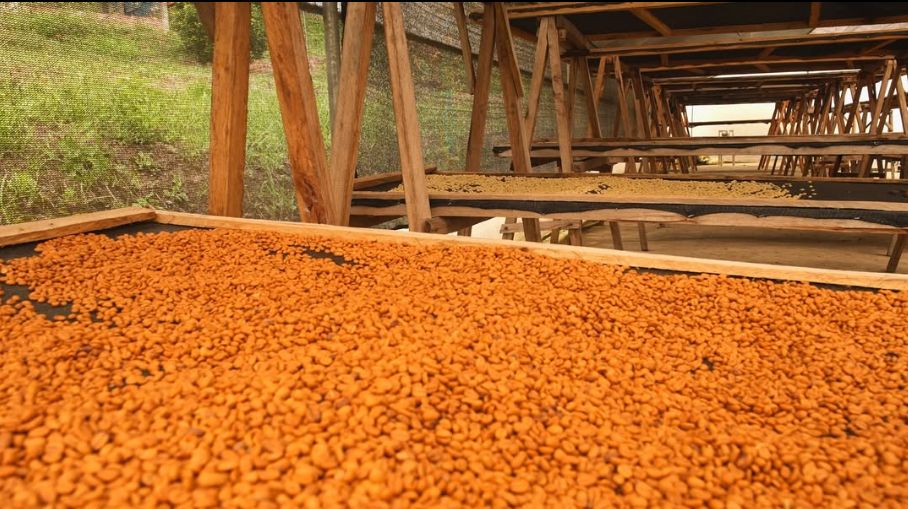
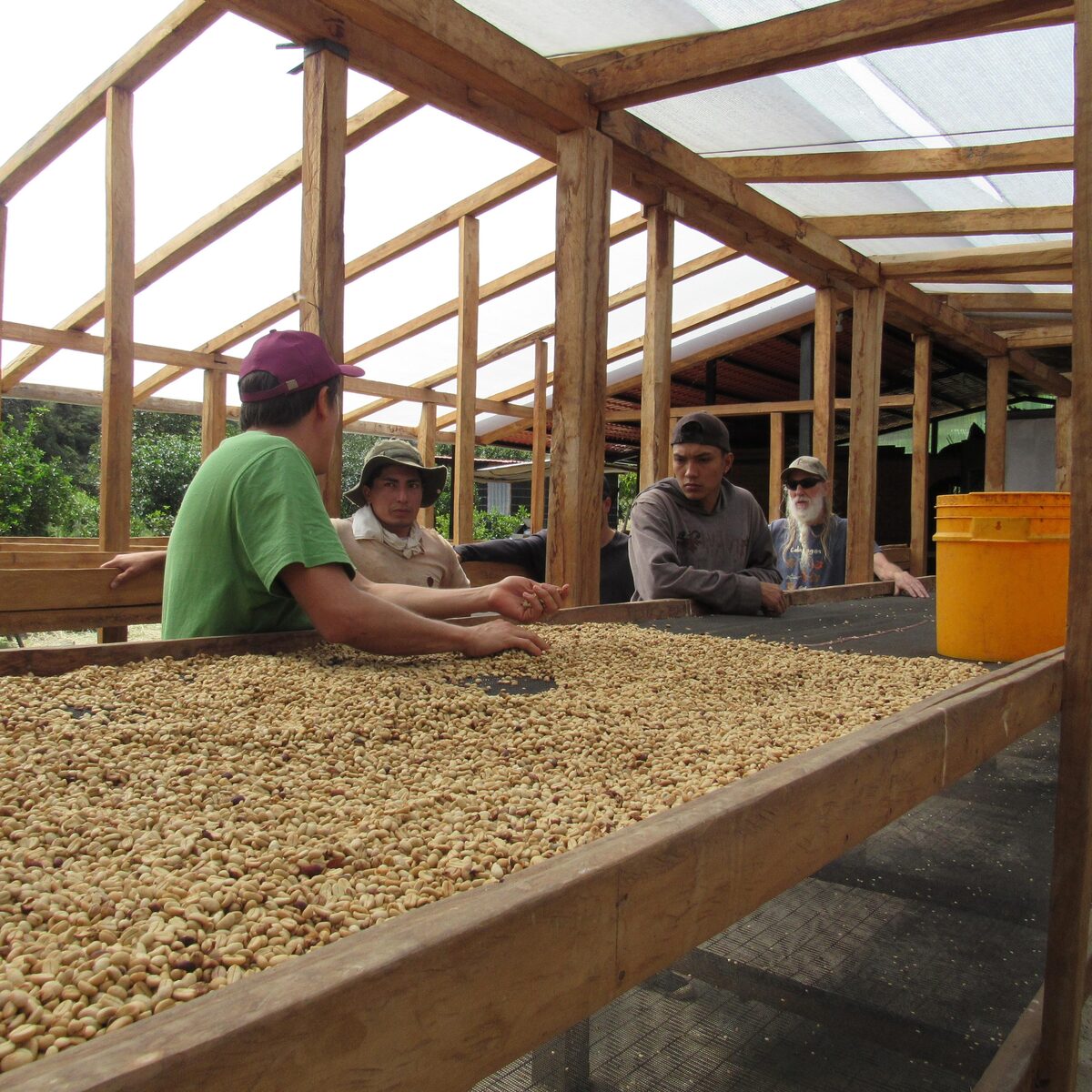
Our raised beds (African beds) are built with mesh suspended over wooden frames, allowing constant, two-way airflow: both above and below the coffee. The coffee is spread in thin layers of 2 to 3 centimeters.
The human element is vital to this system. Our team turns the coffee manually every 30 to 60 minutes during daylight hours to ensure all beans receive equal exposure to air and diffuse solar radiation. We monitor bean temperature constantly. If solar radiation in Loja is too intense and the bean temperature nears 38°C (with a maximum limit of 40°C), we immediately deploy shade cloths (polisombra) to protect the coffee from thermal stress. Drying on raised beds takes 10 to 20 days and is our standard for washed and honey-processed lots.
2. The Dark Room (Controlled Environment Chamber)
For our highly aromatic coffees or those subjected to prolonged anaerobic fermentations, direct sun drying can be too aggressive, evaporating the delicate volatile compounds that define their sensory profile. For these lots, we utilize our climate-controlled dark room.
In this chamber, the temperature is kept constant between 18°C and 22°C, and the relative humidity is regulated between 50% and 55% using industrial dehumidifiers and forced air extractors. The coffee dries slowly and in complete darkness, protected from daytime temperature spikes and ultraviolet radiation. This slow, passive drying stabilizes the bean’s chemical compounds, preserving the delicate floral and fruit esters of our high-end microlots.
The 70-Day Drying Protocol for Carbonic Macerations
The ultimate expression of our technical rigor in drying is applied to our Carbonic Maceration lots—coffees that have placed in the Cup of Excellence Ecuador and have been chosen by competitors in world barista championships. For these coffees, rushing the drying phase is synonymous with destroying their complexity. Therefore, we apply an exclusive 70-day protocol:
- Phase 1: Initial Stabilized Dehydration (15 days in Dark Room): The wet coffee (parchment or cherry) enters the dark room to lose excess free water at low temperatures, protecting the aromatic precursors developed during carbon dioxide fermentation.
- Phase 2: Moisture Equalization (10-day GrainPro Rest): The coffee is collected from the beds and sealed hermetically in GrainPro bags inside our temperature-controlled warehouse. During these 10 days, the coffee “sweats” under controlled conditions; the moisture trapped in the core of the bean migrates to the exterior, balancing the water content uniformly across the entire batch.
- Phase 3: Final Slow Drying (45 days in Dark Room / Raised Beds): The coffee is spread out again for an ultra-slow final drying phase until it reaches exactly 10.5% moisture.
This 70-day protocol allows complex organic acids to round out and integrate within the cellular matrix of the bean, delivering a clean cup with crisp acidity and exceptional shelf life.
Climate-Controlled Storage: Adobe as a Natural Ally
Quality control does not end when the coffee reaches 11% moisture on the drying beds. Green coffee is a hygroscopic product; it absorbs and releases moisture from the surrounding air. If dried coffee is stored in a hot or humid warehouse, it will absorb ambient moisture, raising its water activity and initiating a rapid aging process.
To address this challenge in Malacatos, Loja, we inaugurated the first climate-controlled adobe warehouse in Ecuador in July 2025 at our dry mill. Adobe (compacted mud and straw) is an ancient building material with extraordinary thermal and hygroscopic properties. Its thick walls act as a natural barrier that stabilizes temperature and passively regulates air moisture.
Our adobe warehouse is also equipped with mechanical temperature controls that maintain the space at a constant 18–20°C and 60% to 65% relative humidity. The microlotes, packed in hermetic GrainPro bags or vacuum-packed in panelitas (brick-shaped portions of parchment coffee), are preserved here as if time had stopped. A lot of Hacienda La Florida stored in this warehouse retains its freshness, crisp acidity, and floral notes for up to a year, resisting export voyages without showing signs of aging.
What Well-Dried Coffee Tastes Like
On the cupping table, the impact of impeccable drying is unmistakable. A coffee that has been dried slowly and under strict temperature control is characterized by:
- Clean and Defined Aromas: A total absence of paper, cardboard, dry wood, or musty notes.
- Crisp and Vibrant Acidity: Organic acids remain undamaged by thermal stress during the process.
- Extended Shelf Life: The coffee retains its fresh origin notes for many months after export.
- Roast Uniformity: Lacking internal moisture gradients, the beans absorb heat evenly in the roaster’s drum, avoiding tipping or scorching and ensuring a uniform roast.
Drying is, in the end, the invisible bridge that connects the hard work of wet processing with the art of roasting. At Hacienda La Florida, we understand that excellence has no shortcuts; that is why every bean we produce passes through the uncompromising filter of our drying science.
Drying is the critical preparation before dry milling. We invite you to learn about the next stage of the process in our guide on dry milling in Malacatos, or explore how these moisture and temperature principles apply to our washed process and natural process.
Back to Blog